


by Dorothy King...
Firstly to answer Midas' various points, which he makes regularly: this discussion was about a tomb found at Amphipolis in Macedonia, and not about a temple on the Acropolis in Athens. The Parthenon is lovely, but in my opinion Amphipolis was more important, although both have been heavily politicized by various Greek politicians. I am slightly shocked at the state of education if Midas can't tell the difference, but to help him: Parthenon is on top of a mound, Amphipolis is under a mound.
Dimitris - I appreciate the support, but honestly I don't worry about people who can't tell the difference between the Parthenon and this tomb!
Dimitris - I asked in a previous blog entry about the inscriptions that were supposedly found and taken to the nearby museum. It seems nothing has been heard recently about that and I was wondering if you know anything.
Yes, there were many reports of inscriptions. I think my answer then was that the MC was, to the best of my knowledge. entirely correct in denying that inscriptions had been found that day inside the tomb. The MC was also correct, and no inscriptions were found in the tomb that day.
Were inscriptions found outside the tomb on other days? Yes. I believe that one is at the museum, but others are on the monument, and can be seen in photos released by the MC and taken by journalists when the Prime Minister visited.
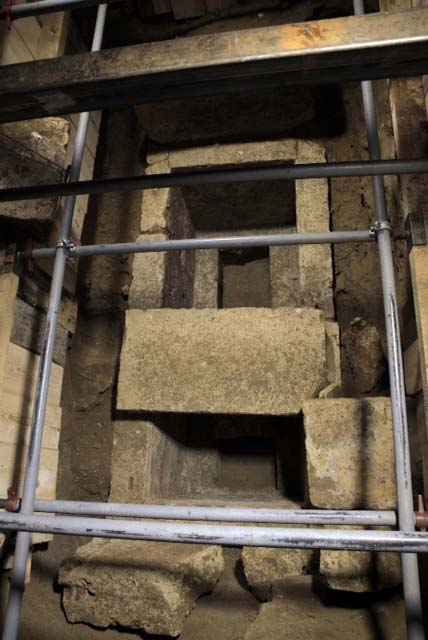
I have answered all previous questions from people who thought they saw writing in photos as "no comment" or "can't comment" and I don't have the time right now to go through everything to find them. But to make the point, this was the very first photograph I looked at. It's on this web site, and I circled the part I would like to discuss. Ideally inscriptions are photographed with different light to make them clear, but this is a monogram which would have been covered in stucco.

This is a coin of Alexander the Great showing one of the monograms he used (source):

This is a coin of Philip III Arrhidaeus with the AT monogram that also appears on many coins with Alexander (source):

This is a coin of Antigonus I Monophthalmus with the AT monogram that also appears on many coins with Alexander (source):

Anyway, I do realise half of Greece is now going to be examining every block photograph under a microscope ... it may not be as exciting as an inscription saying "Alexander tied his horse up here and was buried at Amphipolis" ... but these sorts of monograms were important for dating the temple of Athena at Ilion which Alexander promised in his will.
This evidence is in the photos that have been available since early August, and other better evidence will hopefully be released one day by the MC.
Any thoughts on the following blog post comment from May 2013 found on the blog makedonia-alexandros.blogspot.com?
AnonymousMay 16, 2013 at 3:55 AM
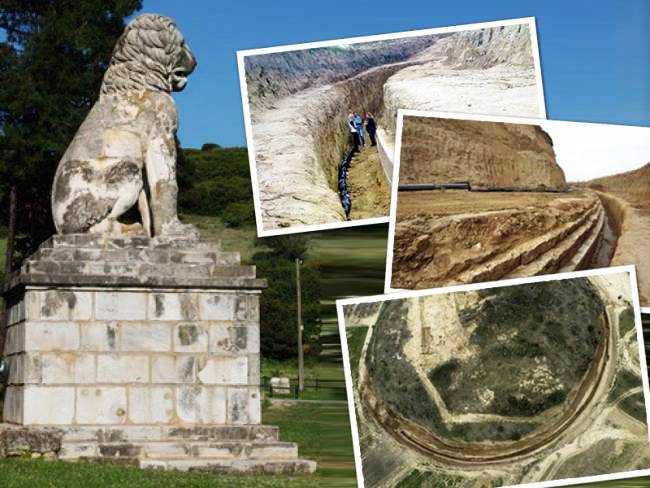
400 blocks from around the Lion, belong to the peribolos (perimeter 500m) of the tomb. The blocks were orthostates, stepsis blocks and geisons for a very long circular wall and exactly the same blocks were found in situ at the peribolos. More than 30 from the rest 100 blocks around the Lion, belong to the basement of the statue, containing blocks with semicolumns semicapitals and...shields. This is the biggest macedonian tumulus ever found and the Lion (not Lionaise) is surely on the top of the tumulus, because all the 430 blocks of the perivolos and the statue basement have the same type and marble elaboration, the same architectural aspects and an entire system of geometrical analogies and an exceptional modulus (the height of the Statue). This same modulus is used also for the construction of the peribolos architecture and the main geometrical form of the tumulus in full analogy with the Lion and its basement. There are no clues about Roxane, the Lion and the marble Shields indicate a Man, propably a heroic warrior(s) of great importance. We cant surely talk about Roxane and Alexander D, as everybody talks so easily at the media all this time. Michaelis Lefantzis,The architect of the excavation
Yes he's brilliant. He was spot on. But that was over a year ago and it's clear they are no longer considering Roxane as they had been a year or two before. Since it is unlikely they found a post-it note saying "Roxane was not buried here" ... they surely had other reasons for changing their minds, and it would be lovely if the MC released that information. Opinions and ideas change constantly during an excavation, almost always based on new evidence. Women could have shields though, particularly in Macedon ...
1)Why the one horse at the mosaic has one blue eye????
2)Have you seen an inscription or any evidence,that has not be announced and reveals the ''own'' of the tomb??
3)Whats your opinion about the ''own'' of the tomb??
1) some horses actually do have blue eyes. It's rare but so do some dogs.
2) heavily implies more than states - nothing that says "this is my tomb"
3) my feeling all along was that this size could only have been built for Alexander, possibly intended as a family mausoleum, but that it was not used for his burial.
Is there to your knowledge any precedent with mosaics having circular marks on the centre similar to the the circular dirt patch in the Amphipolis mosaic? I don't think the mark is natural made(by water or anything else) and the mosaic picture has me thinking that there used to be some small structure there(diameter is about 0,80 meters), probably a small container/altar hosting a fire illuminating the room and the mosaic, just before the marble gates of the 3rd room.(?)
The altar is an interesting idea, but if it had been planned the design of the mosaic would probably have gone around it. If it was added later, marble would stand on it's own and not need to damage below.
Honestly, this is a bit of a puzzle. Water damage seems unlikely. My best guess is that a hole was used for a beam to support the crumbling ceiling? But if so, pieces of it would have been found in the soil.
What's interesting is that the mosaic is in otherwise good condition with no 'buckling' that I can see. To me this suggests that the structural issues are from the weight of the mound above, and not from an earthquake below.
Bronze lamps are more likely to have been used for lighting.
many thanks again for taking the time and initiative to answer questions and many thanks for lots of intriguing hints. One question is about the marbles within the chambers and the circular wall. Some parts are preserved fantastically (e.g. bases of caryatids, part of the tumulus wall) like they were built recently. The marbles on the third chamber, however, appear to be heavily corroded (dark color - e.g: http://www.yppo.gr/images/l_14963.jpg). Also, any idea what are all these colourations in the separating wall here: http://www.yppo.gr/images/l_14749.jpg ? Are all these environmental effects, and if so, why do they seem to have been restricted in certain parts of chambers?
In http://www.yppo.gr/images/l_14963.jpg there seem to be more recent breaks which are bright white, and make the marble look darker. Yes, I would assume that this was due to environmental factors - the MC said there was a delay in working there due to the smell, and that might be linked.
if I follow this logic evolving (according to the "hints") well, why this Alexander's cenotaph (or intended resting place) was decided to be built in Amphipolis and not in Aiges? How such an important monument, by size, if was built to be seen and admired, managed to escape the written sources (e.g. Parian Chronicle - the closest written source to Alexander's death, if my very limited Historic knowledge does not deceive me!)?
I'm sorry but I've posted and answered questions on this so often ... please look at old posts.
And I think that answers all the questions so far.
Πηγή